
Most living rooms look cluttered not because of bad furniture — but because of small, fixable visual mistakes. Wrong bulb colour. Too many cushions. Furniture pushed hard against the wall. These are cheap to fix.
Japandi living room style is built on restraint, natural materials, and warm neutral tones. You do not need to buy a new sofa. You need to remove three things, swap two bulbs, and repaint one wall. This guide shows you exactly how.
Japandi Living Room Colour Hacks That Cost Almost Nothing
Colour is the fastest visual tool you have. The right tones make a budget room read as considered and calm. The wrong ones make even expensive furniture look chaotic.
Warm neutrals — greige, sand, and soft charcoal — are the backbone of the Japandi palette. Most of these changes cost under $40.
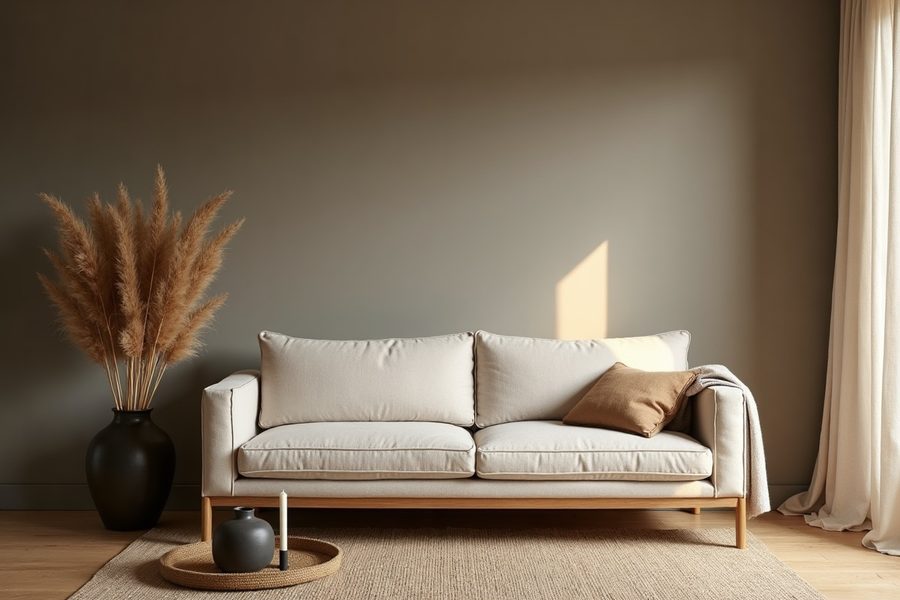
Repaint One Wall in Warm Greige and Let the Rest Stay White

Pick one wall — ideally behind the sofa. Paint it in a warm greige tone. Think Farrow & Ball 'Elephant's Breath' but from a budget brand. Dulux or Valspar both do near-identical dupes for around $30–$40 a can.
That single wall does all the work. The contrast between warm greige and bright white creates depth. The room immediately feels more considered.
Leave the other three walls alone. One accent wall in the right tone is enough.
Use Warm White Instead of Bright White on Trim and Skirting

Cool, bright white trim is the most common thing that kills a Japandi feel. It reads clinical and sharp. Warm off-white — cream or ivory — softens the whole room without touching a single piece of furniture.
Buy a tester pot in a warm ivory tone. Most budget brands sell these for $15–$20. Paint just the skirting boards and door trim.
The shift is subtle but immediate. The room feels softer and less stark.
Layer Charcoal and Sand Tones by Regrouping What You Already Own

Walk around your living room and pull out every cushion, throw, or object that is cool-toned, bright, or patterned. Put them in another room for a week. What remains should be only charcoal, sand, and warm taupe tones.
This costs nothing. You are simply editing the colour story already in the room. Most people find the room looks better immediately — without adding a single new item.
For more ideas on building a coherent Japandi colour palette, see The Ultimate Japandi Living Room Guide: Everything You Need to Know.
Furniture Rearrangement Tricks That Make a Budget Room Read Japandi
You do not need new furniture. You need to move what you have. Placement and negative space are what separate a Japandi room from a standard one. Both are free.
These three rearrangement moves take under an hour each.
Pull Every Piece Six Inches Away From the Wall

Push every sofa, chair, and shelf six inches away from the wall. That gap is called negative space. It makes the furniture look intentional rather than just shoved in place.
This is the single fastest free change in interior design. Rooms feel less cramped and more deliberate. It works in any size space.
Do it right now. It costs nothing.
Remove the Highest Piece of Furniture in the Room

Tall bookshelves and large armoires pull the eye upward. That raises the visual centre of gravity in the room. Japandi spaces sit low — visually and physically.
Find the tallest piece of furniture in your living room. Move it to a bedroom, hallway, or storage. The ceiling feels higher. The room feels quieter.
If you cannot remove it entirely, move it to a corner. A corner placement reduces its visual impact significantly.
Face Seating Toward a Blank Wall Not the TV

Most sofas face the television. That single choice orients the whole room around a screen. Japandi rooms face quiet walls, windows, or low objects.
Try turning your sofa or a single chair toward a blank wall. Place one low object on the floor in front of it — a plant, a tray, a stone. The shift in energy is immediate.
You have bought nothing. You have only changed the direction of attention.
Budget Lighting Swaps Under $40 That Change the Whole Mood
Lighting is the most underestimated budget tool. Wrong bulb temperature alone can ruin a Japandi room — even with perfect furniture and colour. These three swaps cost very little and change everything.
The goal is warm, low, and pooled light. Never overhead. Never cool white.
Switch Every Bulb to 2700K Warm White — Whole Room Shifts for $10

Cool white bulbs (4000K and above) make a room feel like an office. 2700K warm white is the target for any Japandi space. It adds warmth and softness to every surface in the room.
A pack of warm white LED bulbs costs around $8–$12. Replace every bulb in the living room in one go. Do not mix temperatures — consistency matters.
The room will look warmer before you move a single piece of furniture.
Add a $25 Plug-In Rattan or Rice Paper Shade at Floor Level

Plug-in pendants on a cord placed at floor level create pooled light. That low warm glow is one of the most recognisable features of a Japandi room. No electrician needed.
Look for a rattan or rice paper shade with a plug-in cord. Ballpark price is $20–$35. Place it in a corner behind a low chair or beside the sofa.
The floor-level light draws the eye downward. That matches the low visual profile Japandi rooms aim for.
Cover a Harsh Ceiling Fixture With a Wide Washi Paper Drum Shade

If you have a harsh ceiling fixture you cannot remove, cover it. A wide flat drum shade in washi or rice paper diffuses the light and removes the harshness entirely.
These shades slip over most standard fittings without any tools. Ballpark cost is $15–$30. The washi paper gives a warm amber glow rather than direct light.
This is one of the cheapest single changes with the most visible result.
Japandi Living Room Floor Styling Hacks That Look High-End on a Budget

Japandi rooms use the floor as a surface. Low trays, floor-level plants, layered rugs — these details create that calm, grounded feel. None of these need to cost much.
The key is intentionality. One well-placed floor object reads as expensive. Five random objects read as clutter.
Layer a Thin Jute Runner Over a Plain Rug to Add Texture Depth

A plain rug with no texture can look flat and cheap. A narrow jute or seagrass runner laid across it adds natural material depth without replacing the rug.
Jute runners in 2ft x 6ft or similar sizes cost around $20–$40. Lay it across the centre of the existing rug at a slight angle or straight. The layered texture reads immediately as considered.
You are adding material interest for under $40. That is the whole point.
Place a Single Low Tray Directly on the Floor Beside the Sofa

A simple wood or dark lacquer tray placed directly on the floor beside the sofa is a classic Japandi floor vignette. Hold it to one candle and one smooth stone. Nothing more.
Unpainted wood trays or matte black lacquer trays cost under $20 from most homeware shops. The floor placement drops the visual height of the room. The edit to just two objects keeps it from reading as clutter.
This one move takes five minutes and zero skill.
Swap a Standard Side Table for a Flat Stump or Wood Slice at Seat Height

A standard side table is usually too tall and too shiny for a Japandi space. A thick wood slice or natural stump at seat height replaces it immediately. The raw wood surface fits the Japandi material language exactly.
Wood slices and stumps cost $15–$30 from garden centres or Etsy sellers. Choose one with an unfinished or lightly oiled surface. Avoid varnished or lacquered finishes — they read as cheap.
Place it beside the sofa. Put one object on top. Done.
Quick Declutter Edits That Make a Japandi Living Room Look Expensive Instantly
Nothing signals budget like visual clutter. Removing objects does more for a Japandi room than adding them. These three editing decisions are free and take under an hour.
See also: 17 Japandi Living Room Decor Ideas You Will Want to Steal Right Now for more on what to keep and what to remove.
The One-Object-Per-Surface Rule — Remove Everything Else Today

Pick up everything from every surface — coffee table, shelf, windowsill. One object stays. Everything else goes into a box in another room for one week.
At the end of the week, you will find most of it is better in the box. That is not a storage hack. That is the Japandi editing process.
One object per surface. That is the rule.
Store Remote Controls, Cables, and Chargers in One Lidded Box

Remote controls, phone chargers, and cables sitting on surfaces are the fastest way to make a room look unfinished. A single lidded woven box collects all of it in one move.
Lidded woven or matte ceramic boxes cost $10–$20 from most budget homeware stores. Place it on a shelf or side surface. The visual clutter from three or four surfaces disappears at once.
The difference is immediate. No design skill required.
Edit Cushions Down to Two — One Textured, One Plain

Most sofas carry five or six cushions. That is too many for a Japandi room. Two cushions — one with subtle natural texture, one flat plain fabric — is the correct ratio.
Both should sit in the same tonal family: oat, charcoal, warm linen, or sand. No bright colours. No patterns. The simplicity reads as intentional rather than sparse.
Remove the rest today. The sofa will look better immediately.
Affordable Natural Material Swaps That Read as Expensive in a Japandi Room
Synthetic and shiny materials break the Japandi feel instantly. Raw wood, matte clay, and natural linen are what the style is built on. These swaps cost very little individually.
Pick one swap to start. You will see the difference immediately. For inspiration on how top designers approach material choices, Dezeen is a reliable reference point.
Replace Plastic or Glossy Frames With Raw Wood or Black Metal Ones — Around $8–$15 Each

Shiny plastic or ornate gold frames do not belong in a Japandi room. Raw birch, ash, or matte black metal frames are the direct replacement. Each one costs $8–$15 from budget homeware retailers.
Swap two or three frames on your most visible wall or shelf. Keep the same photos — just change the frame material and finish. The room reads differently immediately.
Matte black is the easiest quick win. Raw wood is warmer and more natural.
Swap One Synthetic Throw for an Undyed Cotton or Linen One — Around $20–$35

A polyester or acrylic throw on a sofa reads as cheap regardless of colour. A single undyed cotton or linen throw in oat, flax, or raw white replaces the look entirely.
You only need one. Drape it loosely over one sofa arm. Do not fold it perfectly — let it sit naturally. Ballpark cost is $20–$35 from most budget linen or homeware retailers.
One swap. Not several. That is the point.
Bring In One Unglazed Stoneware or Terracotta Object for Under $15

An unglazed stoneware bowl or terracotta pot placed alone on a shelf reads as considered and deliberate. Glazed and shiny finishes do not — they read as generic homeware. The matte, raw surface is what signals quality.
Small unglazed stoneware bowls and terracotta pots cost under $15 from garden centres, pottery markets, or budget homeware shops. Place it alone. Do not pair it with other objects on the same shelf.
One raw material object in the right spot does more than a shelf of styled pieces.
Conclusion — Shift Your Living Room Toward Japandi Style Without Overspending
You do not need a renovation. You need a different approach to what is already in the room.
Start with three changes today: swap the bulbs to 2700K, pull furniture six inches from the wall, and reduce each surface to one object. Those three moves alone will shift the room visibly.
Work through the rest of the list one section at a time. Each swap, edit, or rearrangement builds on the last. The room gets quieter, warmer, and more considered with each step — without a large spend.
If you want to go deeper into the principles behind the style, 23 Japandi Living Room Ideas That Feel Calm and Effortlessly Beautiful covers the broader design thinking in detail.
Frequently Asked Questions
What is the cheapest way to make a living room look Japandi?
The cheapest changes are free: pull furniture away from walls, remove all but one object per surface, and edit cushions down to two. After that, swap bulbs to 2700K warm white for around $10. These four changes cost almost nothing and have the most visible impact.
What colours work in a Japandi living room?
Stick to warm greige, sand, soft charcoal, and warm white. Avoid cool greys, bright whites, and any saturated colours. A single warm greige accent wall against white surroundings is the fastest colour hack for a Japandi feel.
Can I do Japandi style on a tight budget without buying anything new?
Yes. Rearrange furniture for negative space, edit surfaces down to one object each, regroup existing cushions and throws into warm neutral tones only, and face seating away from the TV. None of these cost anything. The room will read as more intentional immediately.
The Japandi look is not about spending more. It is about keeping less, choosing warmer tones, and placing what remains with intention.
Comments