
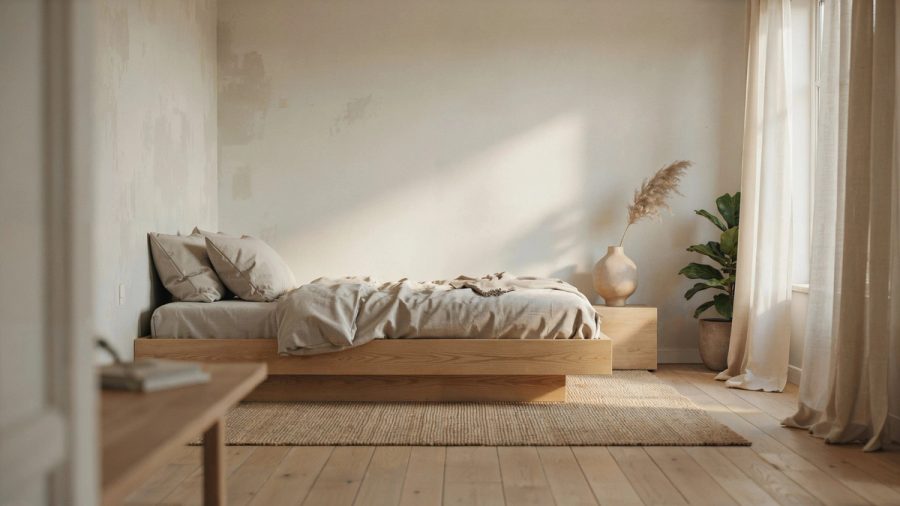
Wake Up Inside the Calm: What a Japandi Bedroom Actually Feels Like
Imagine waking up and the first thing you see is soft morning light filtering through undyed linen curtains, falling across a low timber bed frame and a single ceramic vase on the floor.
There is no clutter, no visual argument between competing colours, no sense that the room is working against you. There is just stillness. That is what a Japandi bedroom feels like — and once you have slept in one, it is genuinely difficult to go back.
Japandi is a design philosophy that sits at the intersection of Japanese minimalism and Scandinavian warmth: it takes the wabi-sabi appreciation for imperfect, natural materials from Japan, and layers in the cosy, functional sensibility of Scandinavian hygge.
The result is a bedroom that is spare without feeling cold, and simple without feeling bare. Here are 21 Japandi bedroom ideas to help you build exactly that.
21 Japandi Bedroom Ideas to Transform Your Space
Idea 1: Go Ultra-Low with a Platform or Floor Bed

The height of your bed is one of the most quietly powerful decisions you will make in a Japandi bedroom. A floor-level or platform bed draws the eye downward, anchors the room to the ground, and creates an immediate sense of calm — there is something psychologically settling about sleeping close to the earth.
It also makes ceilings feel taller and the entire space more open. Look for a solid timber platform frame in oak or walnut with clean, unadorned lines and no ornamentation.
Idea 2: Use a Single Neutral Colour Throughout Walls, Bedding and Floor

Tonal consistency is one of the fastest ways to make a bedroom feel intentional rather than assembled. When your walls, bedding and floor exist within the same narrow colour family — warm whites, soft sand, pale oat — the eye has nowhere to snag, and the room breathes.
This is not about being boring; it is about creating the visual equivalent of silence. If you are working with a limited budget, this approach is also one of the most cost-effective routes into Japandi style —
read more in our guide to [Japandi bedroom on a budget]. For a deeper look at which specific tones work best together, our [Japandi bedroom colour palette guide] is worth bookmarking.
Idea 3: Add a Shoji-Inspired Room Divider or Screen

A shoji screen — or a modern interpretation of one in pale timber and washi-style paper — does several things at once in a Japandi bedroom.
It zones the space without hard walls, diffuses light in the most gentle and flattering way possible, and introduces an unmistakably Japanese visual reference without tipping into pastiche.
In a larger bedroom it can separate a dressing area or reading corner with real elegance. Look for screens with a natural timber frame and translucent rice paper or linen panels.
Idea 4: Layer Textures — Linen, Jute, Cotton — Instead of Colour

In a Japandi bedroom, texture does the work that colour does in other design styles. When your palette is intentionally restrained, the contrast between a rough-weave jute throw, a smooth cotton pillowcase, and a nubby linen duvet cover creates visual interest that is rich without being loud.
Each material has its own quiet character, and layering them builds depth that a colourful room achieves in an entirely different — and far noisier — way. Aim to have at least three different textile weights and weaves on the bed at once.
Idea 5: Keep the Nightstand Brutally Minimal with 1 to 2 Objects Only

The nightstand is the room's most visible surface and the most reliably cluttered one in the average bedroom. In a Japandi style bedroom, it earns its keep by holding almost nothing — a single glass of water, perhaps, or a small lamp and one book you are actually reading.
That restraint is not deprivation; it is the active choice to give your eye somewhere to rest at the end of the day. A low solid-wood side table with no drawer is often enough, because the absence of storage removes the temptation to accumulate.
Idea 6: Bring in One Sculptural Plant Like a Fiddle Leaf or Snake Plant

A single, architectural plant introduces life into a Japandi bedroom without introducing chaos. The keyword here is sculptural — you want a plant whose form is as considered as the furniture around it, not a trailing vine or a busy cluster of small pots.
A snake plant in a simple ceramic pot, or a fiddle leaf fig in a woven basket, earns its place as a living object rather than decoration. For a full guide to choosing the right species for your light levels and space, see our article on [best plants for a Japandi bedroom].
Idea 7: Use Warm-Toned Wood for All Furniture — Oak, Ash or Walnut

Wood is the material backbone of Japandi design, and the tone you choose matters enormously. Cool-toned or painted timber pulls the aesthetic towards Scandi-modern; warm, honey-toned oak or rich walnut keeps it grounded in the earthy, organic quality that makes a wabi-sabi bedroom feel genuinely restful.
Ash sits beautifully between the two if you want something lighter but still warm. The most important principle is consistency — mismatched wood tones fragment a room in a way that no amount of careful styling can repair.
Look for solid wood bed frames, low bedside platforms and benches all within the same tonal family.
Idea 8: Swap Overhead Lights for Paper Lanterns or Washi Pendant Lights

Overhead lighting is one of the most underappreciated enemies of calm in a bedroom.
A central ceiling light flattens a room and strips out shadow, which is precisely the opposite of what you want in a Japandi space. Replacing it with a washi paper pendant or a traditional paper lantern immediately softens the entire room — the light that comes through handmade paper has a warmth and diffusion that no synthetic shade can replicate.
For a considered reading nook, pair a low pendant with a floor lamp in a matching material.
Idea 9: Choose Curtains in Raw Linen or Sheer Cotton

Your curtains are the largest textile surface in the bedroom, and in a Japandi context they should feel like they grew from the wall rather than being applied to it.
Raw, undyed linen in a natural greige or oat tone does exactly that — it has the texture and slight irregularity of a natural fibre that fits seamlessly into a wabi-sabi bedroom aesthetic.
Sheer cotton works equally well for rooms that need maximum light. Hang them from ceiling to floor to elongate the space, and use simple unadorned rods in matte black iron or pale timber.
Idea 10: Add a Wabi-Sabi Ceramic Vase as the Only Decorative Object

If you are going to have a single decorative object in a Japandi bedroom, a hand-thrown ceramic vase is the right one. It embodies wabi-sabi in material form — the uneven rim, the variation in glaze, the slight asymmetry that tells you a human made it rather than a machine.
Place it on the floor, on a low wooden shelf, or on the windowsill with a single dried stem or nothing at all. For more on how to style with imperfect objects, our [wabi-sabi bedroom decor ideas] article goes into real depth.
Idea 11: Use a Tatami-Style Area Rug or Natural Jute Rug

A rug in a Japandi bedroom should feel like an extension of the floor, not a statement piece dropped on top of it. A flat-weave tatami-style rug in natural rush or seagrass connects the room to its Japanese reference points quietly and elegantly.
A chunky jute rug works equally well and tends to be more forgiving underfoot in cooler climates. Either way, keep the colour within your existing neutral palette and resist the temptation to go oversized — a rug that sits just under the lower two-thirds of the bed creates better visual proportion than one that covers the whole floor.
Idea 12: Keep Walls Bare Except for One Piece of Intentional Art

Bare walls are not an absence of design; in Japandi style, they are the design. The negative space on a wall has as much presence as anything you could hang on it, and a bedroom with empty walls feels considered rather than unfinished when the rest of the room is thoughtful.
If you want art — and one piece is enough — choose something that speaks quietly: a small ink brush painting, a single framed textile, a piece of abstract work in earthy tones. Centre it at eye level and leave significant breathing room on all sides.
Idea 13: Try Limewash or Clay Paint for a Textured Organic Wall Finish

Paint is not neutral — and in a Japandi bedroom, the finish matters as much as the colour. Limewash and clay paint create a surface that absorbs and reflects light differently throughout the day, introducing the kind of natural texture and depth that flat emulsion simply cannot achieve.
\They also have the organic, slightly imperfect quality that sits at the heart of wabi-sabi bedroom decor. Both are widely available from specialist paint suppliers and are more achievable as a DIY project than most people expect. For more on styling around textured walls, see our [wabi-sabi bedroom decor ideas] guide.
Idea 14: Use a Low Wooden Bench at the Foot of the Bed

A low bench at the foot of the bed is one of the most functional and aesthetically satisfying additions to a Japandi bedroom. It provides a place to sit when dressing, a surface to lay tomorrow's clothes without using the floor, and a visual anchor that extends the bed's horizontal line through the room. Keep it in the same timber tone as your bed frame, and resist adding cushions or throws to it — its value is partly in its plainness. Look for a simple solid-wood bench with no backrest and minimal joinery detail.
Idea 15: Hide All Storage Completely Using Ottomans, Built-Ins or Under-Bed Drawers

Visible storage is the single fastest way to undermine a calm bedroom, regardless of how tidy it is. In a Japandi context, the goal is not just tidiness but the complete absence of visual reminders that storage exists at all.
Under-bed drawers built flush to the platform frame, built-in wardrobes with handle-free push-to-open doors, or a clean-lined ottoman that doubles as a linen chest — all of these absorb the practical realities of life without letting them intrude on the room's stillness. If you cannot hide it, consider whether it belongs in the bedroom at all.
Idea 16: Let Natural Light In with Unlined Linen Curtains

Natural light is not just a practical consideration in a Japandi bedroom — it is a design material. The quality of light that comes through an unlined linen curtain on a bright morning has a warmth and softness that no lamp can replicate, and the way it shifts through the day gives the room a sense of aliveness that is difficult to articulate but immediately felt.
If privacy is a concern, layer sheer unlined panels behind a heavier linen drape rather than reaching for blackout lining, which deadens a room entirely.
Idea 17: Go Monochromatic with Warm Greige or Soft Sage Green

A monochromatic Japandi bedroom is not one colour — it is a single colour explored in every tone, texture and material it can occupy. Warm greige is the most forgiving choice: it reads as almost-white in bright light and deepens to something closer to taupe by evening, making the room feel subtly different at different times of day.
Soft sage green introduces a natural, botanical note that connects indoors to outdoors. Both palettes work with warm wood and natural textiles without effort. For budget-conscious execution of this approach, our [Japandi bedroom on a budget] article has specific guidance.
Idea 18: Use Bonsai or Moss as a Living Decor Element

There is something deeply Japanese about the act of tending a living thing as a form of design.
A bonsai on a low wooden shelf, or a moss arrangement in a shallow ceramic dish, brings the wabi-sabi principle of impermanence into the room in a way that a plastic plant or a print never could. These are slow, quiet things that ask something of you — regular water, occasional repositioning towards the light — and that relationship with a living object is itself part of the Japandi aesthetic.
Our guide to [best plants for a Japandi bedroom] covers care requirements for both.
Idea 19: Add a Floor Cushion or Zabuton for a Japanese-Style Sitting Corner

A zabuton — the flat, firm floor cushion used in Japanese homes for seated meditation and rest — is a small addition that carries significant cultural weight. In a Japandi bedroom, a floor cushion in undyed cotton or linen placed beside a low shelf or beneath a window creates a sitting corner that is explicitly separate from the bed, giving the room a sense of intentional ceremony.
It also reinforces the floor-level orientation that characterises the best Japandi bedroom decor. Choose a thick, firm cushion rather than a decorative one — it should actually be usable.
Idea 20: Choose a Bed with No Headboard for an Ultra-Minimal Feel

Removing the headboard is a design decision that feels radical until you try it, and then it feels obvious.
A bed without a headboard removes one of the bedroom's most visually dominant elements, returning the wall behind the bed to neutral, restful space. It works particularly well in combination with a low platform frame, where the absence of a headboard reads as a considered choice rather than an unfinished one.
If you feel the wall needs something, a single horizontal shelf mounted at bed height — holding just one or two objects — achieves the same grounding effect with even more restraint.
Idea 21: Apply the Rule of Three — Every Surface Has a Maximum of 3 Objects

The rule of three is not a styling trick — in a Japandi bedroom, it is a discipline.
Every surface in the room: the nightstand, the low shelf, the windowsill, the bench at the foot of the bed — holds a maximum of three objects, and each of those objects must justify its presence. If it is not functional, it must be genuinely beautiful in a quiet way.
If it is not beautiful, it must be purely functional. Anything that is neither leaves the room. This one principle, applied consistently, will do more for your bedroom than any amount of new furniture.
Frequently Asked Questions About Japandi Bedroom Style
What is Japandi bedroom style?
Japandi bedroom style is a design approach that blends Japanese minimalism with Scandinavian warmth. It draws on the Japanese philosophy of wabi-sabi — finding beauty in imperfection and natural materials — and the Scandinavian focus on functionality, cosiness and restraint. The result is a bedroom that is calm, spare and deeply considered, using natural materials like solid wood, linen, ceramic and stone. It prioritises feeling over decoration and longevity over trend. A [Japandi bedroom colour palette guide] is a good starting point for understanding the visual language.
How do I make my bedroom look Japandi on a budget?
The most cost-effective Japandi bedroom changes cost almost nothing: edit what you already have by removing objects from surfaces, rehang curtains closer to the ceiling, and swap out a colourful duvet cover for an undyed linen one. Beyond that, focus on one material upgrade at a time — a jute rug, a hand-thrown ceramic vase, a washi paper pendant light. Japandi is explicitly not about buying more things; it is about choosing fewer, better things. Our full guide to [Japandi bedroom on a budget] covers this in more detail.
What colours are used in a Japandi bedroom?
Japandi bedrooms work within a deliberately narrow palette of warm, natural neutrals: off-white, oat, warm sand, soft greige, clay, and occasionally muted sage green or dusty terracotta. These are not stark whites or cool greys — the warmth in the tone is non-negotiable, because it is what makes the space feel lived-in rather than clinical. Colour is introduced primarily through natural materials — the amber of oak timber, the pale cream of linen, the matte stone-grey of ceramic — rather than through paint or textiles.
What is the difference between Japandi and minimalist bedroom?
Minimalism is primarily a visual philosophy — it is about reduction, absence and clean surfaces. Japandi shares that commitment to reduction but adds something minimalism often lacks: warmth, texture and a deliberate appreciation for imperfect natural materials. A minimalist bedroom can be cold, hard and almost clinical in its precision. A Japandi bedroom is spare but inviting — the textures are tactile, the materials are organic, and the imperfections are intentional. It is the difference between a room that has been emptied and a room that has been curated with care.
Start with One Idea — That Is Enough
Japandi bedroom ideas are not a checklist to complete before the aesthetic counts. This is a design philosophy built on the idea that less, done thoughtfully, is always more than more, done carelessly. You do not need to renovate, re-paint and re-furnish to feel the shift — swap your curtains for unlined linen, clear everything from one surface, or move your bedside table to the floor. Start there. The rest follows naturally once you have felt what even a single change can do to the quality of a morning. If this article gave you something useful, save it to Pinterest or share it with a friend who needs a calmer bedroom.
Comments