
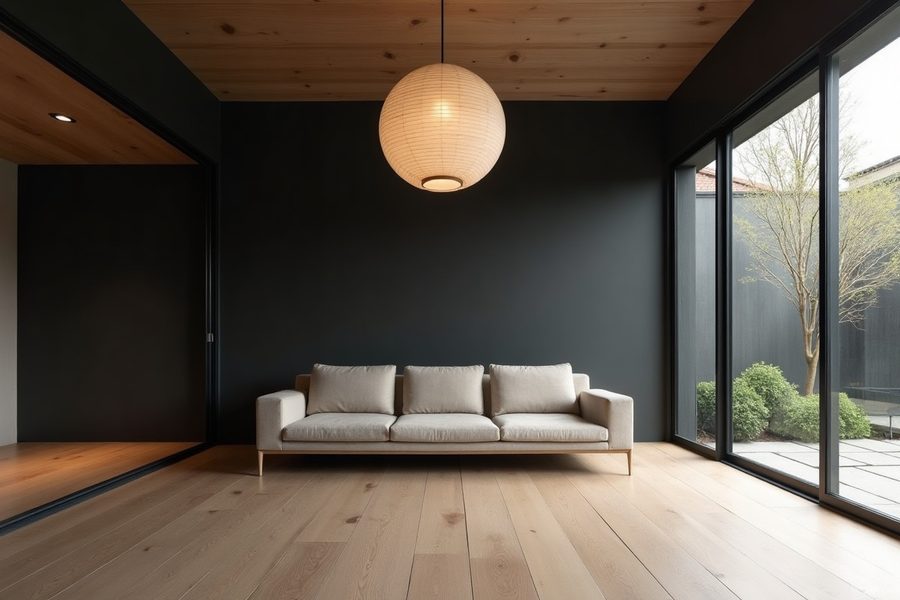
Most Japandi rooms you see online are pale, airy, and flooded with white light. That version is fine. But it is not the only version.
Dark Japandi living rooms use charcoal, navy, and forest green as their base. Light wood sits against those deep walls, and the contrast does something remarkable. The room feels grounded, quiet, and genuinely atmospheric — not just minimal.
Why Dark Japandi Living Rooms Work — and What Makes Them Different
In a pale room, negative space can disappear into the background. In a dark Japandi living room, negative space becomes visible. The gaps between objects feel intentional.
Light ash or pale oak wood pops sharply against a charcoal or navy wall. You notice the grain, the texture, the material itself. The darkness does the work that accessories would otherwise do.
This approach also deepens the wabi-sabi principle — the Japanese idea that imperfection and transience are worth noticing. Dark walls make raw materials look more raw. Linen looks more worn. Ceramics look more handmade. For a full foundation on this style, read The Ultimate Japandi Living Room Guide: Everything You Need to Know.
Ash Plywood Low Console Against a Charcoal Feature Wall

A flat, low ash plywood console — around 120 cm wide and 35 cm deep — placed flush against a charcoal wall is one of the strongest moves in dark Japandi design. The pale ash grain reads almost luminous against the dark background.
Nothing else is needed on or near it. The contrast ratio between the wood and wall handles all the visual interest. Keep the surface clear or place one object maximum.
Burl Oak Side Table Floating Against Deep Navy

Burl oak has an irregular, swirling grain pattern that looks almost like a natural painting. Against a deep navy wall, that grain becomes the focal point of the entire room.
Position the table with deliberate negative space around it — at least 40–50 cm of clear wall on each side. No accessories. The table itself is the detail. Burl oak side tables in this style run approximately $120–$280.
Raw Linen Floor Cushion Stack on Dark Green

Two or three raw, undyed linen floor cushions stacked near a forest green wall replace the need for a sofa entirely. The floor-level seating reads as deliberate, not casual.
Linen in its natural, barely-processed state — slightly rough, slightly uneven — contrasts beautifully with the depth of a dark green wall. This is low, calm seating with a clear material logic behind it. Individual linen floor cushions typically cost $40–$90 each.
Folded Washi Drum Shade at Near-Floor Height

Most washi paper pendants hang at ceiling height. Hang one unusually low instead — close to coffee table height, around 40–50 cm from the floor.
The light pools into a small, intimate zone within the dark room. It does not light the whole space. It lights one moment of it. That restraint is exactly what dark Japandi requires.
Hinoki Wood Slab Shelf Mounted on a Concrete-Effect Wall

A single live-edge hinoki slab, roughly 60–80 cm long, mounted as a floating shelf against a concrete-effect dark wall draws immediate attention. The pale, fine-grained wood against the rough grey surface creates a quiet but sharp contrast.
Place one object on it. A small clay bowl or a single ceramic piece. Nothing more. The shelf itself carries the visual weight here, not what sits on it.
The Furniture-Facing Wall Rule for Dark Accent Placement

Always paint the wall that your seating faces — not the wall behind the sofa. This is the furniture-facing wall rule, and it matters.
You look at that wall for hours. It anchors your experience of the room. A dark charcoal or navy on that surface sets the entire mood without making the room feel enclosed from all sides.
This single decision is often the difference between a dark room that feels atmospheric and one that feels oppressive. Design authorities like Aura consistently reference focal-wall placement as a key principle in moody interior schemes.
Handwoven Charcoal Kilim Laid Flat Without Layering

A single handwoven charcoal kilim — no layering, no runner placed on top — works as a dark ground plane that anchors the room without competing with the walls.
The geometric pattern in a traditional kilim stays visible against dark flooring because the rug itself is the darkest surface in the lower half of the room. Flat, single-layer placement keeps the visual logic clean. Good handwoven kilims start around $180–$400 for a 160 x 230 cm size.
White Slip-Cast Bud Vase on a Dark Shelf

Against a dark wood shelf and a dark wall behind it, a single white slip-cast ceramic bud vase reads almost like a light source. The white object catches whatever ambient light exists in the room.
One piece. Nothing else on the shelf. The contrast between the white ceramic and the dark surround is the entire idea. Slip-cast bud vases in matte white typically cost $25–$65.
Matte Finish Dark Paint vs Eggshell — Which Reads More Japandi

Matte paint absorbs light. It deepens the colour and removes any surface hardness. Matte finish is the correct choice for dark Japandi walls.
Eggshell has a slight sheen. In a dark colour, that sheen can make the wall feel harder and more commercial. It reflects rather than absorbs, which works against the quiet, grounded mood you are building.
For charcoal, navy, or forest green in a Japandi living room, always specify matte. It is a small decision with a large effect.
Single Cast Iron Plant in a Matte Stone Pot Against Navy

The cast iron plant — botanical name Aspidistra elatior — is one of the few plants that genuinely thrives in low light. Its long, architectural leaves in deep green read beautifully against a navy or charcoal wall.
One plant. One matte stone pot in grey or dark clay. Nothing placed near it. The Aspidistra's upright, structural shape suits the low-profile, uncluttered logic of dark Japandi exactly.
Conclusion

Dark Japandi is not about making a room feel smaller or heavier. It is about making every material and every gap between objects visible and intentional.
The ideas above all follow the same logic: one strong contrast, no excess, and a deep wall colour that makes light wood and pale ceramics do the work.
Frequently Asked Questions
What wall colours work best in a dark Japandi living room?
Charcoal grey, deep navy, and forest green are the three strongest choices. All three provide enough contrast for light wood tones to stand out clearly. Matte finish is essential for all of them.
Do dark walls make a Japandi living room feel too small?
Not if you keep furniture low-profile and surfaces clear. Negative space — empty wall, empty floor — reads more visibly against a dark background than a light one. A dark room with few objects can feel more spacious than a cluttered pale room.
What wood tones work against dark Japandi walls?
Ash, pale oak, and hinoki are the strongest choices. Their light, fine grain contrasts sharply against deep walls. Avoid dark walnut against dark walls — the contrast disappears.
Dark Japandi is a patient style. It rewards restraint more than any other approach to the room.
Comments