
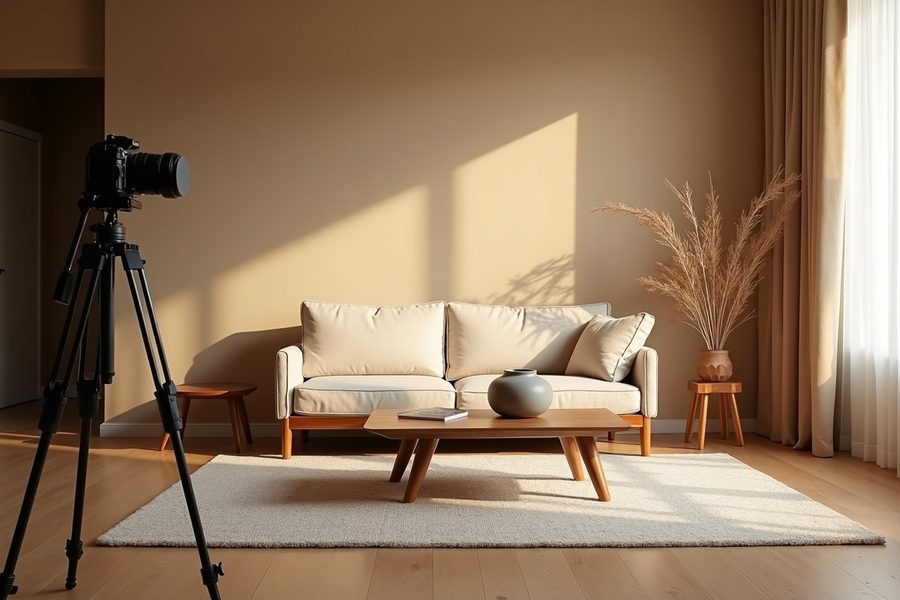
The Japandi room you're pinning and the Japandi room you're building are not the same project. The rooms on Pinterest are styled for a camera lens — every object placed at an angle, every surface cleared of real life, every shadow falling just right. They are photographs, not floor plans.
That gap is where most Japandi living room mistakes happen. Readers aren't making errors of taste. They're copying a still image without the philosophy behind it. This guide breaks down the seven mistakes that trip up even careful decorators — and gives you a concrete fix for each one. For the complete picture, explore our full guide: Japandi Style Explained: The Complete Beginner Guide to Japandi Decor.
Mistake #1: Stripping the Room So Bare It Stops Feeling Human

You clear the coffee table. You remove the cushions. You take down every wall object. The result looks exactly like the pin — for about five minutes.
Then it starts feeling cold. Not calm. Cold.
This happens because empty rooms photograph well but live badly. A staged Japandi room has nothing on the surfaces because objects cast shadows and clutter the frame. That's a photography choice, not a design principle.
What to Do Instead: Bring Back One Wool Throw and a Single Woven Rug in Raw Jute or Undyed Wool

Drape a chunky wool throw in natural oatmeal over one arm of your sofa. Lay a raw jute or undyed wool rug — roughly $80–$180 for a 2m × 3m — under the coffee table. You'll find even more ideas in Japandi vs Scandinavian Design: What Is the Actual Difference?.
These two additions restore tactile warmth without re-cluttering the room. The goal is a space that looks considered, not empty.
Mistake #2: Reaching for Crisp White Walls Because 'Neutral' Feels Safe

Most people associate "neutral" with stark white or cool grey. That association comes from Scandinavian interiors, which do use cooler tones.
Japandi neutrals run warmer — and the difference matters more than almost any other single decision in the room. Crisp white walls make a Japandi living room read as generic minimalism, not the quiet warmth the style is actually after.
What to Do Instead: Test Paint in Aged Linen, Unpainted Plaster, or Warm Oat — Not Bright White

Order sample pots in aged linen, unpainted plaster, or warm oat tones. Brands like Farrow & Ball and Little Greene both carry warm off-whites in this range — expect to pay around $15–$25 per sample pot.
Hold each swatch against your floor, your sofa, and your natural light. The right colour should look like the room exhaled, not like a dentist's waiting room.
Mistake #3: Filling Every Surface Because Empty Shelves Look Unfinished

You arrange three candles, two small vases, a stack of books, and a trailing plant on one shelf. It looks full. It also looks like a shop display.
Small objects grouped in clusters photograph well in flat-lay shots. In a real room, they just read as visual noise.
One considered object does more work than five average ones. This is the part of Japandi philosophy that matters practically: restraint isn't about having less, it's about choosing better.
What to Do Instead: Place One Unglazed Stoneware Bowl or a Single Ceramic Bottle Vase — Then Stop

Choose one unglazed stoneware bowl (around $30–$60) or a ceramic bottle vase in a matte clay finish. Set it on the shelf or coffee table. Then leave that surface alone.
If you want to read more about building a Japandi space from the ground up, the The Ultimate Japandi Living Room Guide: Everything You Need to Know covers the full framework.
Mistake #4: Combining Three Different Wood Tones With No Shared Temperature

You have a pale oak coffee table, a medium walnut TV unit, and dark ebony shelving. Each piece is lovely on its own.
Together, they look like a furniture showroom where nothing was chosen together. The room feels restless.
Wood tones don't need to match — but they do need to share an undertone. Warm woods alongside cool woods fight each other without a clear reason.
What to Do Instead: Anchor on Two Tones in the Same Warmth Family — Pale Ash With Warm Walnut, or Cool Oak With Charcoal

Audit your existing pieces. Pair pale ash with warm walnut if you're working in warm tones. Use cool grey oak alongside charcoal if your room leans cooler.
Cap the room at two wood tones, three at most. For design inspiration on how professionals handle this kind of material layering, Dezeen regularly publishes Japandi and minimalist interiors worth studying.
Mistake #5: Buying the Chair That Photographs Well but Nobody Wants to Sit In

You find a sculptural low-slung chair in woven rattan. It looks extraordinary in the product photo. You order it.
Six weeks later, it lives in the corner. Everyone sits on the sofa.
A Japandi living room is built on function as much as form — that's the Scandinavian half of the philosophy. Furniture that doesn't get used undermines the whole point of the style.
What to Do Instead: Apply the Sit-and-Stay Test — If You Won't Use It for 30 Minutes, It Has No Place in a Japandi Room

Before buying any seating, ask yourself whether you would genuinely sit in it for half an hour. If the answer involves "maybe with the right cushion" or "probably not daily," skip it.
Choose a low-profile sofa in natural linen ($600–$1,400) or a solid-framed armchair with a back that actually supports you. Comfort and visual quiet are not opposites in this style.
Mistake #6: Painting Smooth Matte Walls and Wondering Why the Room Feels Flat

You paint the walls a warm oat tone. You've nailed the colour. The room still feels like something is missing.
Plain, smooth painted walls read as flat to the eye. Even with the right warm tone, there's nothing for light to catch or hands to register.
Japandi rooms rely on material texture as much as colour — the surface itself needs to feel like something. A smooth painted wall, however warm, doesn't offer that.
What to Do Instead: Apply a Limewash or Tadelakt-Style Plaster Finish, or Hang a Hand-Loomed Wool Panel on the Largest Wall

Limewash paint ($40–$80 per litre, covering roughly 10–12m²) creates a soft, chalky depth that shifts with natural light. Tadelakt-style plaster finishes go deeper but reward the effort with a surface that looks almost organic.
If you're renting or working on a lower budget, a hand-loomed wool wall panel in undyed cream or warm charcoal gives the same tactile quality without any wall alteration.
Mistake #7: Running the Whole Room off One Bright Ceiling Fixture

A single overhead fixture lights every corner equally. It's efficient. It's also the fastest way to strip a Japandi living room of any atmosphere.
Flat, even light removes shadow — and shadow is how a room develops depth and mood. The camera doesn't need shadow. You do.
Japandi lighting is meant to pool in corners, not flood from above. That quality of light is why the styled rooms you pin look so quiet and considered.
What to Do Instead: Add a Rice-Paper Floor Lamp, a Warm Pendant at 2200K–2700K, and One Low Table Lamp — All Below Eye Level

Place a rice-paper floor lamp ($60–$130) in one corner of the room. Hang a warm washi-paper pendant over the seating area. Add one low ceramic table lamp on a side table or console.
Use bulbs rated between 2200K and 2700K across all three sources. That range produces the warm amber glow you see in every well-photographed Japandi living room — and it's achievable with standard LED bulbs.
Frequently Asked Questions
What warm neutral colours work best in a Japandi living room?
Look for warm whites and off-whites with yellow or pink undertones rather than blue ones. Aged linen, warm oat, raw plaster, and mushroom are all strong starting points. Avoid cool greys and stark whites — they pull the room towards generic minimalism instead of the warm restraint Japandi is built on.
How many wood tones can you mix in a Japandi living room?
Two is the comfortable limit, three if they share the same temperature family. Pair warm tones together — pale ash with walnut — or cool tones together — grey oak with charcoal. Mixing warm and cool wood tones without a clear system is what makes a room read as accidentally assembled rather than intentionally layered.
Why does my Japandi living room still look wrong even though I followed the style?
The most common reason is copying the visual output of a styled photo without the decisions behind it. Check these first: are your neutrals warm or cool? Is your lighting layered or single-source? Do your surfaces have at least one piece of tactile texture — a woven rug, a linen cushion, an unglazed ceramic? Usually one of those three is the source of the problem.
The Japandi room you want takes time to develop. Start with one or two of these fixes, not all seven at once.
Comments