
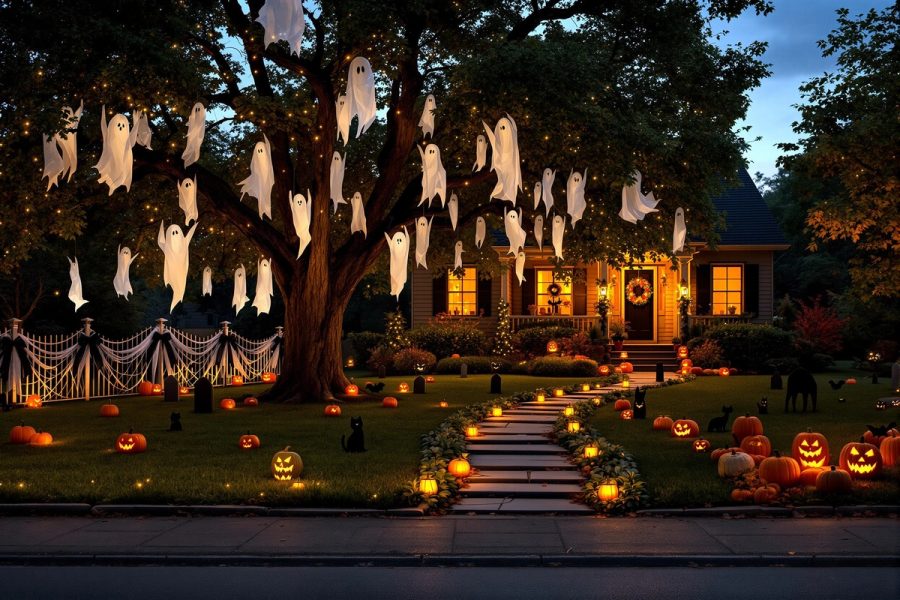
A fully dressed front yard on Halloween night reads completely differently from a porch with a few props. That kind of front yard halloween decoration doesn't happen by following a prop list. Most outdoor halloween decorations ideas online are shopping lists that ignore what your yard actually looks like. This guide is different — every one of the 16 halloween front yard decorations below is anchored to something already in your yard, a real feature you build around instead of compete with. It works just as well if your yard is doubling as an outdoor halloween party space this year.
Established Trees: Using Branch Structure for a Ghost and Lighting Display
Why the Branch's Natural Fork Determines Placement

Look for the Y-shaped forks where two branches meet — natural anchor points that hold weight evenly and space elements at the tree's own rhythm. The tree's structure dictates spacing and height, no guesswork, no zip ties every six inches. For the complete picture, explore our full guide: Halloween Decor Ideas: 20 Spooky Stylish Designs That Elevate Every Room.
Ghosts at the Forks, Light on the Trunk

Hang white gauze ghost forms ($8–$15 each) from three or four forks at different heights. Wind warm micro-LED string lights only around the trunk and main branches. The natural gaps between forks become the negative space that makes the display read eerie rather than busy.
Price history tracked · tap to check current price on Amazon
 = Price stable
 Set of 3 Light Up Ghosts with Timer Remote
Price history · 16 weeks
 ✦ Editor's pick
 Marlrin Solar Lanterns Outdoor Waterproof
Price history · 16 weeks
 ↑ Price rising
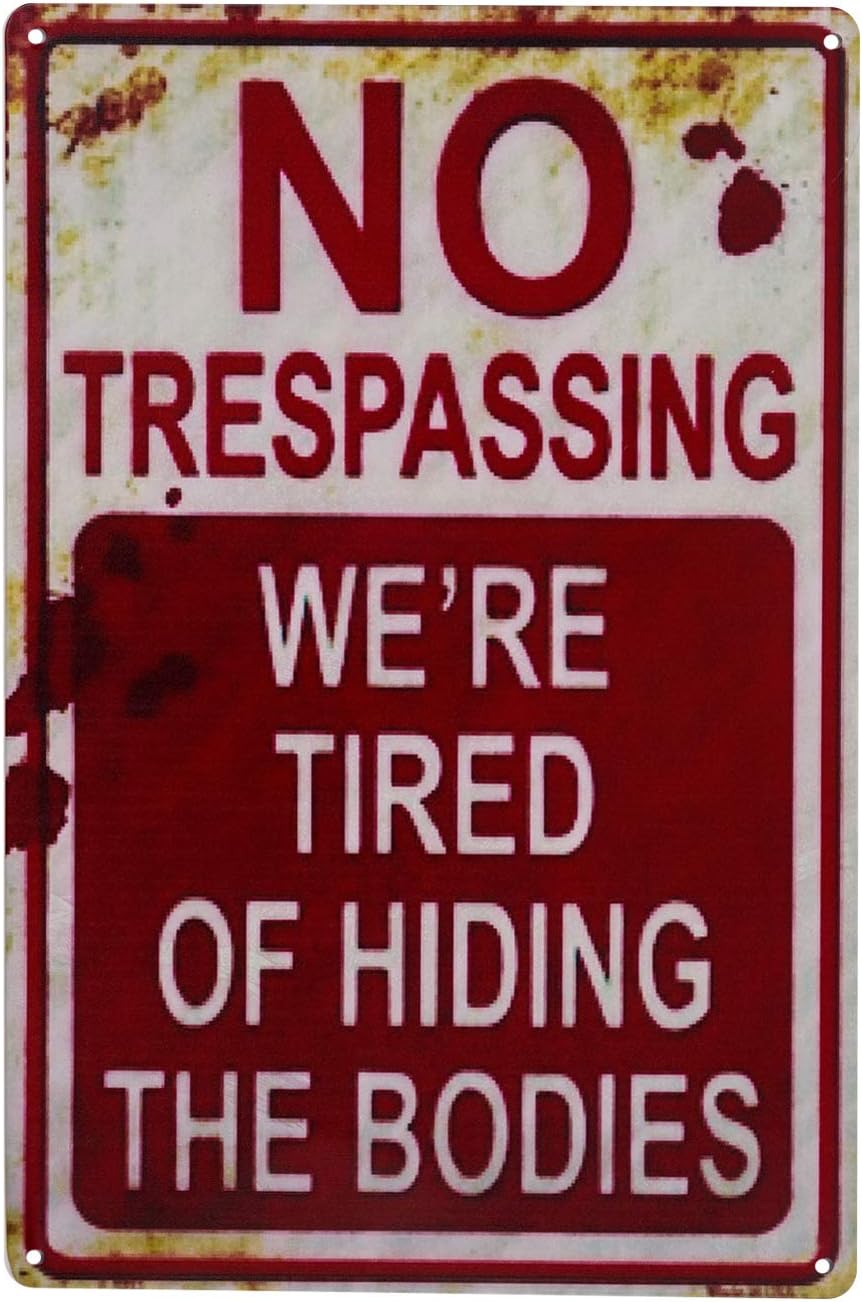
 Halloween Signs Retro Fashion
↑ At peak — price may drop
Price history · 16 weeks
Garden Beds and Flower Borders: Letting Dried Seed Heads Do the Work
Why the Bed's Own Dying Plants Are Already Halloween-Coded
Ornamental grasses gone silver, dried hydrangea heads, and spent rudbeckia stems are already standing in most October beds. A bed's existing dried texture reads more atmospheric than any prop planted into it, because it's genuinely seasonal, not seasonal-coded.
One Spray-Paint Trick Instead of Added Props

Lightly matte-black spray a handful of the bed's own dried seed heads and ornamental grass plumes from 30cm away, keeping most of the bed natural. Painting what's already growing costs nothing and reads considered — planting new props into a bed almost always reads like an afterthought. You'll find even more ideas in Dark Halloween Aesthetic: 14 Moody Elevated Designs That Are Scary Chic.
The Front Walkway: A Cobweb Runway Strung Between Existing Path Plantings
Stretching Web Netting at the Path's Natural Width

Use stretch cobweb netting ($4–$8 per bag) anchored to whatever already flanks your path — shrub branches, fence posts, low garden stakes — pulled taut at knee height on one side and waist height on the other. Anchoring to existing plantings instead of adding new posts keeps the path's real width and sightline intact.
Varying the Tension So It Doesn't Read Flat
Pull the netting tighter in the middle of the path and looser near the ends, so it sags and catches evening light unevenly. Uniform tension reads like packaging material; uneven tension reads like a web that's actually been there a while.
The Open Lawn: Spacing a Graveyard Scene With Real Negative Space
Why Three Tombstones Beat a Dozen

Choose three to five tombstones ($12–$30 each), spaced no closer than 90cm apart, each angled slightly differently. Open grass between props is part of the display — negative space is what makes individual pieces register from the street.
Let Ground Fog Move Through the Gaps
Add one low ground-fog effect ($30–$60) to reinforce the scene. The fog only works as atmosphere if there's actual open space between tombstones for it to move through.
Foundation Planting Beds: Close-Up Vignettes Right Against the House
Why This Zone Runs at Half Scale

Guests see this bed from 1–2 meters away; the street barely notices it at all. Use mini pumpkins, single taper candles, and short feather picks kept under 25cm tall. Proximity to the house compresses scale — oversized props here compete with the facade instead of complementing it.
Tuck, Don't Stack
Push each small piece between existing plants rather than lining them up. Tucked pieces read as part of the planting; lined-up pieces read as a shelf display propped against the house.
The Driveway Edge: Painted Ground Stencils Guests Actually Walk Over
Chalk-Paint Stencils on the Pavement Itself

Use washable driveway chalk paint and a bat, spiderweb, or cracked-earth stencil ($10–$18) directly on the concrete near the street end of the driveway. Using the pavement itself as the canvas means zero storage, zero props to weatherproof, and it washes away in one rinse come November.
Keep It to One Motif, Repeated
Repeat a single stencil motif two or three times along the edge rather than mixing shapes. One repeated motif reads like intentional signage; several different shapes read like leftover stencils used up at random.
Mailbox and Lamp Post: One Restrained Wrap, Not a Cluster of Add-Ons
The One-Wrap Rule

Wrap the post in loose, uneven coils of black gauze ribbon ($4–$8 per roll) and stop. Mailbox and lamp post are pedestrian-scale, not street-scale — one simple wrap reads clearly; anything more competes with the rest of the yard.
A Single Accent, Not a Theme
Add one small ribbon bow at the mailbox flag or lamp base, nothing else. This is one of the fastest front yard halloween ideas diy in the whole guide, under $15 and twenty minutes. A second accent immediately turns a detail into a separate attraction.
Existing Shrubs and Hedges: Wrapping Real Greenery With Gauze and Low Light
Volume Is What Makes Gauze Work

Drape cheesecloth loosely over a dense, rounded shrub at least 60cm across. Gauze needs volume behind it to read as a veil — on a thin, sparse shrub it just looks like litter caught in the branches.
Light From Inside, Not On Top
Tuck one or two battery LED nodes into the shrub's center so light glows through the gauze from within. Light glowing from inside the gauze reads as an object; light aimed at gauze from outside just reads as a lit sheet.
The Fence or Property Line: Flat Silhouettes Sized for Contrast
Matching Silhouette Tone to Fence Color

Use 30–45cm silhouettes in matte black on light fences, or dark charcoal (not pure black) on dark wood fences. Contrast between cutout and fence surface is the only thing that makes silhouettes read at street distance — matching tones disappear into each other.
Spacing for Individual Impact
Space silhouettes at least 60cm apart so each one reads as its own shape. Silhouettes placed too close together merge into one dark blob rather than a readable scene.
Stone Borders and Garden Edging: Staking Light Along What's Already There
Following the Line the Eye Already Uses

Push stake-mounted solar lights into the soil just inside existing stone or metal edging, spaced 30–40cm apart. The existing edge gives the lighting a logic — eyes follow the line, which creates atmosphere that scattered spotlights never achieve.
Connecting Zones Across the Property
Run this same lighting where your edging meets the fence line from the section above. Linking two zones with the same lighting treatment is what starts making a yard read as one property, not several separate displays.
Under the Tree Canopy: Layered Hanging Displays at Multiple Heights
Three Heights, Not One

Hang gauze ghosts at eye level (180cm), dried herb bundles at chest height (120cm), and small pumpkins at knee height (60cm). One hanging element at eye level, one above, one near the ground is what keeps a canopy open and readable, not just dark.
Leaving Air Between Layers
Leave at least 45cm of visual gap between each height. The open air between layers is what creates depth — concentrating everything at one height flattens the whole effect.
Unused Lawn Corners: A Self-Contained Pumpkin Vignette
Why a Corner Contains a Grouping

Place three to five pumpkins in descending size into a corner where two edges converge — driveway meets fence, or fence meets fence. Two converging edges give a grouping a natural boundary — an open lawn gives it none, and the same pumpkins there read as randomly placed.
Anchoring the Back Angle
Lean one or two dried corn stalks into the corner's back angle. This is one of the simplest front yard landscaping ideas in the whole guide, and it uses space that was doing nothing. A single anchoring element at the back keeps the grouping from reading like it's sliding out of the corner.
Garden Steppingstones and Paths: Lighting the Ground Plane
Placing Light Beside the Pavers, Not On Them

Use flat disc solar lights immediately beside each steppingstone in the soil, never on top where they're a trip hazard. Light at foot level pulls a guest forward — overhead string lights alone illuminate a space but don't direct movement the way ground-plane light does.
Layering With Overhead Light
Add string lights at canopy height above the same path for a two-plane effect. Ground light and overhead light read as separate planes rather than competing sources when used together.
The Gate or Entry Point: Marking Where Halloween Begins on the Property
Wrapping the Threshold Itself

Wrap gate posts in black satin ribbon in wide diagonal stripes, with one feather wreath per post at eye height. A defined threshold tells guests the display is designed, not scattered — everything inside it reads as curated once the entry point is clear.
A Sign That Says Nothing
Hang a blank, weathered board instead of a lettered sign. An unmarked, aged board reads more unsettling than a sign that spells out "Beware" — the blank space does the work.
Windows and House Facade: Silhouette Decals That Read as Shadows at Night
Static-Cling Shapes on the Glass

Apply static-cling bat or witch silhouette decals to window panes facing the street, positioned where interior light will cast them as shadow-shapes after dark. A silhouette on the glass itself reads as something inside the house, which is a different, quieter effect than lighting the outside of the house.
One Window, Not Every Window
Choose one or two windows near the entry rather than decorating every pane. Decals on every window read like a costume shop display; one or two read like something a passerby has to look twice to notice.
Whole-Property Styling: The One Rule That Ties Every Zone Together
The Light Temperature Problem No Guide Addresses

Zone 1 has warm string lights, Zone 10 has cool-toned solar stakes, Zone 15 has something else entirely — each zone looks fine alone, but together they fight. Conflicting light temperatures make each zone read as its own unrelated project instead of one property.
One Temperature, One Palette, Everywhere
Choose warm amber or cool white and apply it to every zone — trees, edging, path, gate. Then pick two colors max and hold them across the whole yard. A single light temperature and a two-color palette applied everywhere is what turns sixteen good ideas into one front yard landscaping design, rather than sixteen separate ones.
Frequently Asked Questions
What are the best outdoor halloween decorations for a yard with no obvious focal point? Start with the driveway edge stencils or the gate wrap — both create a clear focal point without needing a large standalone prop. Work inward from there using the corner and open-lawn sections.
How do I make front yard halloween decorations look designed rather than cluttered? Keep one consistent light temperature across every zone and hold to a two-color palette. Clutter almost always comes from mixing colors and light temperatures, not from having too many props.
Can outdoor halloween decorations work for a small yard? Yes — pick three or four zones instead of all sixteen: the mailbox wrap, the foundation bed vignette, the window decals, and one lawn or bed treatment. Fewer well-executed zones read more cohesive than many scattered across a small space.
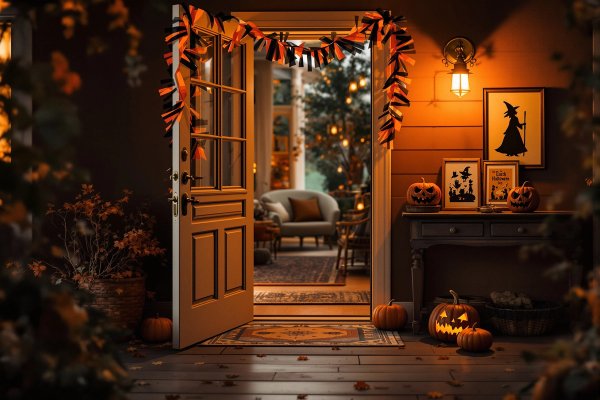
Which zone are you starting with this year? Save this guide of halloween decorations outdoor projects and work through the property zone by zone, and pair it with our Halloween porch decor guide for everything between the gate and the front door.
Comments